

Medical education in Saudi Arabia is growing quickly. There are more medical schools, more students per cohort, and more pressure on hospital rotations to give each student real time with patients. At the same time, every graduate is expected to meet one national standard: the SaudiMEDs competency framework. On top of that, the Saudi Medical Licensing Exam (SMLE) from the Saudi Commission for Health Specialties (SCFHS) controls access to internship-to-practice pathways and postgraduate training.
This guide explains how students in Saudi medical schools can use VCliniq alongside their curriculum. It covers what SaudiMEDs asks of you, how each VCliniq activity maps to those competencies, and a study rhythm that runs from the pre-clinical years to SMLE preparation.
What Is SaudiMEDs?
SaudiMEDs is the national framework that describes the competencies an undergraduate medical graduate in Saudi Arabia should have. Saudi medical colleges use it to write their program learning outcomes, and it draws on international models such as CanMEDS while adding local priorities: the Saudi healthcare system, community health, and Islamic, legal, and ethical principles in practice.
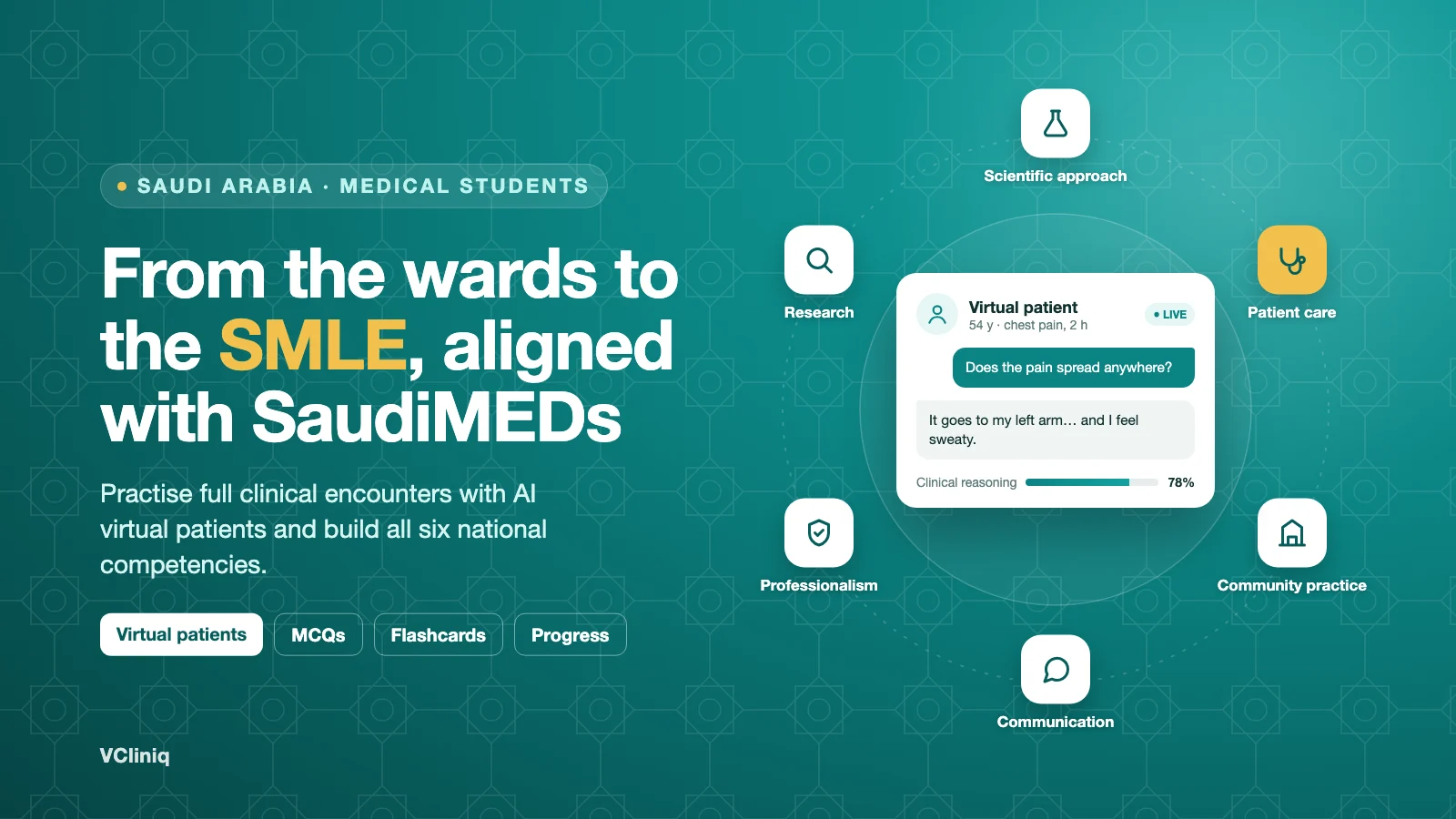
The framework is organised into six themes:
- Scientific Approach to Practice: applying basic, clinical, behavioural, and social sciences to patient care, and practising evidence-based medicine.
- Patient Care: taking histories, examining patients, building differentials, choosing investigations, and managing common and urgent conditions safely.
- Community-Oriented Practice: understanding the Saudi healthcare system and advocating for health promotion and disease prevention.
- Communication and Collaboration: communicating clearly with patients and families, and working well in interprofessional teams.
- Professionalism: professional attitudes and behaviour, Islamic, legal, and ethical principles, self-reflection, and lifelong learning.
- Research and Scholarship: asking good clinical questions, appraising evidence, and contributing to knowledge.
Each college turns these themes into its own course outcomes, so the exact wording in your study guide may differ. The six themes are the same everywhere.
How SaudiMEDs Connects to the SMLE
The SMLE is a computer-based, English-language multiple-choice exam delivered through Prometric. Its blueprint is reviewed by SCFHS and is designed to reflect what a safe new graduate should know, which is why it follows the same competencies SaudiMEDs describes. Questions are mostly clinical vignettes across medicine, surgery, paediatrics, and obstetrics and gynaecology, with ethics and professionalism woven through.
In practice, this means the skills that make you strong on the wards are the same ones that score points on the exam: reading a presentation, prioritising a differential, and picking the safest next step.
Always check the source. Eligibility rules, attempt limits, fees, and the current blueprint are set by SCFHS and change over time. Read the latest SMLE applicant guide on the SCFHS website before you register.
The Gap VCliniq Helps Close
Most Saudi students describe the same problem: plenty of lectures and question banks, but not enough repetitions of the full clinical encounter. In a busy teaching hospital you may watch a resident clerk a patient, but you rarely get to:
- Take the whole history yourself, in your own order
- Decide which examination findings matter
- Choose investigations and see results
- Commit to a diagnosis and a plan
- Get detailed feedback on every step
VCliniq's AI virtual patients give you that full loop as many times as you need, at any hour, without risk to a real patient.
Mapping VCliniq to the Six SaudiMEDs Themes
1. Scientific Approach to Practice
What VCliniq offers
- Virtual patient cases that require you to link symptoms, signs, and results to the underlying pathophysiology
- AI feedback that explains why a finding matters, not only whether you were right
- MCQ practice with explanations that reinforce the science behind each answer
How to use it After each case, read the feedback and write one sentence that explains the key mechanism in your own words. Add that sentence to a flashcard deck so you review it with spaced repetition.
2. Patient Care
This is the core of VCliniq and the biggest part of both SaudiMEDs and the SMLE.
What VCliniq offers
- Conversational history taking: you ask the questions, and the patient answers the way a real patient would, including vague or incomplete answers
- Physical examination and investigations: you request what you think is needed and interpret the results
- Diagnosis and management: you commit to a differential, a final diagnosis, and a plan
- Structured evaluation of each step, so you can see where your reasoning went off track
How to use it Work through cases by presenting complaint (chest pain, fever in a child, abdominal pain, vaginal bleeding in pregnancy, shortness of breath). These match the high-yield presentations in clerkships and on the SMLE. Aim for breadth first, then repeat weak presentations until your approach feels routine.
3. Community-Oriented Practice
What VCliniq offers
- Cases built around conditions that matter in Saudi public health, such as diabetes, obesity, hypertension, sickle cell disease, thalassaemia, and road traffic trauma
- Prompts to consider prevention, screening, and follow-up, not just the acute problem
How to use it When you finish a chronic-disease case, ask yourself three questions: What screening would have caught this earlier? What lifestyle or family counselling is needed? Where in the Saudi system (primary healthcare centre, specialist clinic, hospital) should this patient be followed? Your instructor can turn these into assignment prompts.
4. Communication and Collaboration
What VCliniq offers
- Open-ended conversation with the patient, so the way you phrase questions affects what you learn
- Practice explaining a diagnosis and plan in plain language
- Instructor-assigned cases where results are shared with your course team
How to use it Practise the opening and closing of each encounter as carefully as the middle. Introduce yourself, confirm the patient's concerns, and summarise back before you move on. These habits transfer directly to OSCE stations.
5. Professionalism
What VCliniq offers
- A private space to make mistakes and reflect on them without judgement
- Progress tracking that shows how your performance changes over time
- Cases that include consent, confidentiality, and ethical decisions
How to use it Keep a short reflection log. Once a week, look at your progress page, pick one pattern (for example, "I order too many investigations" or "I miss red flags in paediatric fever"), and set one goal for the next week. Self-reflection and professional development are named outcomes in SaudiMEDs, and this is an easy way to show evidence of both.
6. Research and Scholarship
What VCliniq offers
- Feedback that refers to accepted guidelines and evidence-based practice
- Exposure to many presentations of the same condition, which helps you notice patterns and ask better questions
How to use it When a case surprises you, look up the current guideline and compare it with what you did. Students who do this regularly often find topics for case reports or audit projects during their clinical years.
A Year-by-Year Plan for Saudi Students
Pre-Clinical Years
- Use flashcards to lock in anatomy, physiology, pharmacology, and microbiology
- Try one simple virtual patient case a week to see how the science shows up at the bedside
- Use MCQs at the end of each block to check understanding
Clinical Years (Clerkships)
- Before each rotation, complete 5–10 VCliniq cases in that specialty so you arrive with a working approach
- During the rotation, after seeing a real patient, find a matching virtual case and run through it yourself
- Complete any cases your instructor assigns through your course; your results go to them as structured evaluations
OSCE Preparation
- Run cases out loud, as if an examiner were listening
- Focus on a complete, focused history in a limited time
- Practise summarising each case in under one minute
For a deeper look at station strategy, see our OSCE exam guide.
SMLE Preparation (Final Year and Internship)
A balanced weekly rhythm in the final months might look like this:
| Activity | Purpose | Suggested time |
|---|---|---|
| Question bank blocks (timed) | Exam format, stamina, breadth | Most days |
| VCliniq virtual patient cases | Clinical reasoning, "next best step" decisions | 4–6 cases a week |
| VCliniq MCQs by specialty | Targeted review of weak areas | 2–3 sessions a week |
| Flashcard review | Retention of high-yield facts | 15–20 minutes daily |
| Progress review | Adjust the plan | Once a week |
Spread your effort across medicine, surgery, paediatrics, and obstetrics and gynaecology, and don't neglect ethics and professionalism scenarios, which appear across all of them.
For Saudi Medical Colleges and Instructors
VCliniq also supports faculty who need to show how their program meets SaudiMEDs and accreditation requirements:
- Courses and assignments: instructors can build courses, assign specific cases, and set due dates for each cohort
- Structured evaluations: every attempt produces a consistent, criteria-based record of history, examination, diagnosis, and management
- Cohort analytics: see which presentations or competencies a class is struggling with and adjust teaching
- Evidence for quality assurance: student performance data can support program reviews and NCAAA accreditation reports
If your college would like to discuss a pilot, contact our team.
Getting Started
- Create an account and explore the case library
- Start with a familiar presentation to learn how the interface works
- Read every feedback report: that is where most of the learning happens
- Add what you learn to flashcards so you keep it
- Check your progress weekly and set one small goal
Conclusion
SaudiMEDs describes the doctor every Saudi medical graduate should become, and the SMLE checks that you are ready for safe practice. Both reward the same thing: sound clinical reasoning built from many repetitions of real patient encounters.
VCliniq gives Saudi medical students those repetitions on demand: virtual patients to practise the full encounter, MCQs and flashcards to build knowledge, and feedback and progress tracking to turn practice into steady improvement. Used alongside your college curriculum and clinical rotations, it can help you build all six SaudiMEDs competencies and approach the SMLE with confidence.
This article is general guidance and is not affiliated with or endorsed by SCFHS. For official SMLE eligibility, registration, and blueprint details, refer to the Saudi Commission for Health Specialties.